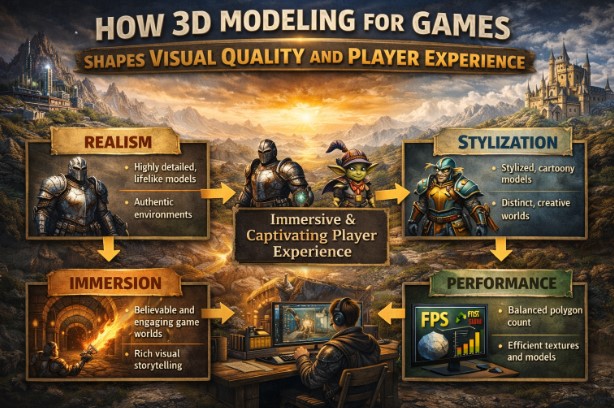
First things that strike the eyes of most players when they are introduced to a new game, usually well before the investigation of mechanics, story, or controls, are visuals. Quality always gets judged unconsciously by how the characters move, how the environments feel, and how believable this world seems.
Lying at the heart of such visual perception is 3D modeling for games, which turns creative ideas into tangible, interactive elements that players see and engage with throughout their experience.
From realism and style to performance and immersion, modeling decisions shape far more than just aesthetics-they shape how the game feels to play.
Quality Visuals Start with the Basics
Every onscreen visual of a game starts its life in some sort of 3D model. Characters, props, and environments depend on their modeling quality to look great on screen. Badly built models can make even the best-textured assets feel awkward or unpolished.
High-quality modeling is about:
- Clean silhouettes that read well from many angles
- Proper proportions seem natural in motion
- Structural Accuracy to Support Animation & Lighting
If models are designed with care, added textures and effects enhance them rather than mask errors.
The Link between Modeling and Art Direction
It is the art direction of a game that determines whether its identity will be realistic, stylized, cartoon-like, or abstract. Modeling plays a great part in keeping this identity constant throughout the in-game world.
Consistent modeling helps:
- Guarantee cohesive visuals between characters and environments.
- Reinforce the game’s tone and genre.
- Avoid immersion-breaking inconsistencies.
For example, exaggerated proportions might fit within the stylized nature of a game but be completely out of place in another, more realistic setting. Modeling decisions should therefore be in line with the artistic intent throughout.
Improving Realism without Sacrificing Performance
Game realism is about much more than the level of detail-what’s important is how believable a game is: players will notice if objects act naturally, whether characters move convincingly, or when an environment feels properly grounded.
Good modeling increases realism through:
- Using accurate anatomy and structure
- Avoid unnecessary complexity.
- Supporting Natural Deformation during Animation
Meanwhile, the models must be optimized for real-time performance. Too much geometry or poorly designed form can result in low frame rates and responsiveness, directly impacting player enjoyment.
How Modeling Affects Animation and Movement
Good modelling is always the cornerstone of good animation. A clean topology and well-thought-out geometry allow the smooth deformation of characters and objects without distortion.
Strong modeling means:
- Natural Character Movement
- Smooth combat and interaction animations
- Clipping and deformation issues have been reduced.
Poorly designed models force the animator to work around technical limitations, resulting in stiff or unnatural movement, which players usually catch onto right away.
Gameplay Clarity and Player Readability
It means clarity plays the most important role in visuals. Identifying the characters, enemies, things to interact with, and hazards should definitely be swift.
It has the following effects on readability:
- Defining clear shapes and silhouettes
- Avoid visual clutter
- Supporting consistent scale and spacing
3D modeling within game production flows right into how easily players understand on-screen information, and can affect the player’s reaction time or decision-making.
Immersion Inside the Environment and World-building
Game worlds are telling stories visually. History, culture, and mood come across using architecture, props, terrain, and environmental details without words or dialogue.
Effective environment modeling allows:
- Establish emotional tone
- Intuitive guiding of the player’s exploration
- Design realistic, lived-in spaces
Even the subtleties, like worn edges or asymmetry, can add a great degree of realism and presence to environments.
Supporting Cross-Platform Experiences
Most modern games have a simultaneous release to PC, console, and mobile devices; modeling quality should consider a wide range of hardware capabilities while maintaining consistency in the overall visual feel.
Well-planned models can:
- Scale with Level-of-Detail Systems Effectively
- Adapt to different performance budgets
- Appearance is the same on all screens
That flexibility also allows developers to offer similar experiences without completely separate asset sets.
Collaboration & Professional Pipelines
With game development getting more and more complex, many studios collaborate with external partners on developing assets. Cooperation with experienced 3D modeling services makes sure that models will meet both the artistic and technical requirements right from the start.
Professional pipelines emphasize:
- Clean topology with optimized geometry
- Consistent scaling and naming conventions
- Compatibility with modern game engines
This reduces revision cycles and increases overall production efficiency.
Player Perception and Emotional Connection
Whereas the quality of modeling is hardly analyzed consciously by players, its effect is definitely there to be felt: smooth animations, believable characters, and immersive environments do contribute to emotional engagement.
High-quality modeling:
- Builds trust within the game world
- Strengthens immersion.
- Encourages longer play sessions.
Most games are increasingly evolving after launch in updates, expansions, and downloadable content. Models designed to be scalable, therefore, stay relevant throughout the life of the game.
Long-term value is most important for franchise-based games and live-service ones.
Conclusion
From first impressions to long-term engagements, 3D modeling for games has played a definitive role in shaping visual quality and player experience: it informs realism and performance, animation and gameplay clarity, artistic vision with technical stability in support. It makes the games more immersive, responsive, and memorable by treating modeling as a foundational process rather than a visual afterthought for players.