Introduction
A car accident changes things quickly. One moment you’re driving through Vancouver traffic; the next you’re dealing with pain, stiffness, medical appointments, and the confusing landscape of an ICBC claim — all at once.
The physical recovery part doesn’t have to be as complicated as the paperwork. ICBC’s active rehabilitation program is designed to help accident survivors move from injury to function, and kinesiologists play a central role in making that happen.
If you’ve been in a motor vehicle accident in British Columbia and you’re wondering how an ICBC kinesiologist in Vancouver can help — what they do, what’s covered, and what the process looks like — this guide answers all of it.
What Is ICBC Active Rehabilitation?
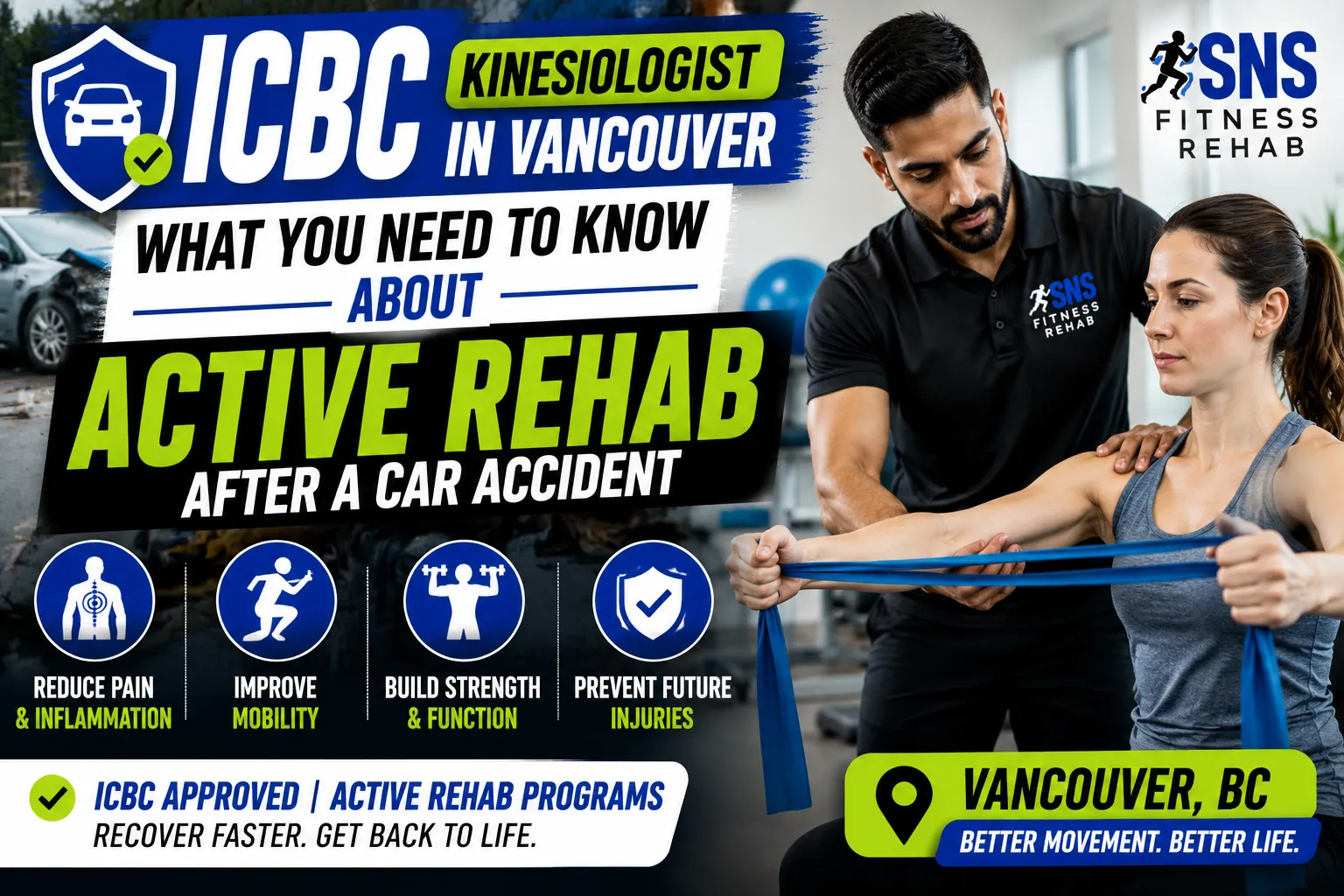
ICBC active rehabilitation is a covered benefit for people injured in motor vehicle accidents in British Columbia. Unlike passive treatments that are done to you — massage, chiropractic adjustments, ultrasound — active rehabilitation is exercise-based. It’s designed to help you rebuild strength, restore function, and reduce pain through progressive physical activity guided by a trained professional.
The philosophy behind active rehab is grounded in solid evidence: movement, when correctly prescribed, heals injuries more effectively than rest alone. And for the majority of soft tissue injuries common in vehicle collisions — whiplash, muscle strains, joint sprains — progressive exercise is the primary recovery mechanism.
Kinesiologists are one of the regulated health professional groups approved by ICBC to deliver active rehabilitation services. Under ICBC’s Enhanced Care model (introduced in 2021), most accident survivors have access to a defined number of treatment sessions without needing to prove fault in an adversarial claim process.
What Does an ICBC Kinesiologist Actually Do?
An ICBC kinesiologist in Vancouver does far more than lead you through a generic exercise class. Their role is clinical, individualized, and outcome-driven.
Here’s what the active rehabilitation process typically looks like:
Initial Assessment
The first appointment focuses on understanding your current functional status:
-
A detailed review of the accident mechanism and injury history
-
Assessment of pain levels, location, and behavior (what makes it better or worse)
-
Functional movement testing — range of motion, strength, balance, and coordination
-
Review of any imaging or reports from your physician or physiotherapist
-
Discussion of your pre-accident activity level and rehabilitation goals
This assessment forms the foundation of your individual active rehabilitation plan. Nothing is generic — the exercises are selected based on what your body needs, not a standard protocol.
Active Rehabilitation Program Design
Based on the assessment, your kinesiologist designs a progressive exercise program targeting your specific injuries. For most vehicle accident survivors, this includes some combination of:
-
Cervical and thoracic mobility exercises — particularly for whiplash-associated disorders affecting the neck and upper back
-
Core stabilization — rebuilding the deep trunk muscles that protect the spine
-
Postural re-education — addressing the changes in posture and muscle activation patterns that often develop in response to pain
-
Lower extremity strengthening — for injuries affecting the hips, knees, or ankles
-
Balance and proprioception training — restoring the sensorimotor systems that are often disrupted after injury
-
Gradual return to pre-accident activities — whether that’s returning to work, recreational sport, or daily physical tasks
Ongoing Progress Monitoring
ICBC active rehabilitation isn’t a static program. Your kinesiologist monitors your response to treatment at each session, adjusting exercises, load, and volume based on how your body is recovering. When progress stalls, the program is updated. When milestones are reached, the focus shifts to higher-level function.
This responsiveness is what separates effective rehabilitation from simply going through the motions.
Documentation for Your ICBC Claim
Your kinesiologist will document your progress throughout the rehabilitation process. This documentation — which captures functional limitations, improvements, and ongoing barriers to recovery — can be an important part of your ICBC file, particularly if your recovery is more complex or prolonged than initially expected.
Working with a kinesiologist at a clinic experienced in ICBC cases, like SNS Fitness Rehab, ensures that your progress is documented in the clinical language that ICBC understands.
Common Injuries Treated Through ICBC Active Rehab
Most vehicle accidents in Vancouver involve rear-end or side-impact collisions, and the injury patterns that result are fairly consistent:
|
Injury Type
|
Description
|
How Active Rehab Helps
|
|
Whiplash (WAD)
|
Soft tissue injury to neck structures from rapid acceleration-deceleration
|
Cervical mobility, deep neck flexor strengthening, postural correction
|
|
Low back strain
|
Muscle and ligament injury to lumbar region
|
Core stabilization, lumbar mobility, progressive loading
|
|
Shoulder injury
|
Rotator cuff strain, AC joint sprain from impact or bracing
|
Scapular stability, rotator cuff strengthening, overhead progression
|
|
Knee injury
|
Impact-related soft tissue damage
|
Quad/hamstring strengthening, proprioception, gait retraining
|
|
Concussion
|
Mild traumatic brain injury
|
Graded return to exercise protocol, vestibular rehabilitation
|
|
Psychological impact
|
Anxiety, fear of movement, PTSD related to the accident
|
Graduated exposure, education, collaborative care with psychology
|
The concussion and psychological components deserve particular attention — both are increasingly recognized as important parts of the vehicle accident recovery picture, and kinesiologists working within ICBC active rehab are trained to incorporate these dimensions into their programs.
How ICBC Enhanced Care Coverage Works for Kinesiology
Since the Enhanced Care model was introduced in May 2021, ICBC coverage for active rehabilitation has changed significantly. Here’s a simplified overview:
-
Who is covered: Most people injured in motor vehicle accidents in BC are eligible under Enhanced Care, regardless of fault
-
What is covered: A defined package of treatments, including sessions with kinesiologists, physiotherapists, chiropractors, and massage therapists
-
How to access it: You register your injury with ICBC following the accident and are connected to a treatment provider network
-
How long coverage lasts: Coverage duration depends on the nature of your injuries, with complex cases receiving more extended benefits
ICBC active rehabilitation benefits for kinesiology typically include a set number of sessions. Your treatment provider will work directly with ICBC on the billing and pre-authorization side, meaning you can focus on your recovery rather than paperwork.
For the most current and accurate information about ICBC active rehabilitation benefits and coverage limits, it’s best to check directly with ICBC’s official website or speak with your ICBC adjuster.
Why Choose SNS Fitness Rehab for ICBC Active Rehab in Vancouver
Not all rehabilitation clinics have the same experience with ICBC active rehab cases. When choosing an ICBC kinesiologist in Vancouver, you want a clinic that:
-
Understands the ICBC billing and documentation process
-
Has experience with the full spectrum of vehicle accident injuries — from straightforward soft tissue injuries to complex multi-system cases
-
Offers access to complementary rehabilitation modalities when needed, such as hydrotherapy for clients who need low-impact initial conditioning
-
Can transition you from active rehab into general personal training as you approach full recovery, ensuring continuity of care
-
Communicates collaboratively with your other healthcare providers — physiotherapist, physician, psychologist
SNS Fitness Rehab’s team at their Vancouver clinic brings all of these elements together under one roof — a significant advantage when your recovery requires multiple modalities working in coordination.
Returning to Sport After a Vehicle Accident
For Vancouver’s large population of active adults — people who ski, cycle, run, play hockey, or participate in recreational sports — returning to their pre-accident activity level is often the most important goal.
This is where the crossover between ICBC active rehab and sport-specific training becomes especially relevant. The active rehabilitation phase rebuilds the foundational capacity — range of motion, basic strength, pain-free movement. The sport-specific phase translates that capacity into the demands of your sport.
The transition between these phases shouldn’t be a cliff edge — it should be a seamless handoff managed by a team that understands both the clinical rehabilitation picture and the performance demands on the other side.
Tips for Getting the Most Out of Your ICBC Active Rehab
Starting ICBC active rehabilitation is a commitment. Here’s how to maximize the value of the process:
-
Start as soon as you’re cleared — earlier rehabilitation engagement correlates with better outcomes in most soft tissue injuries
-
Be honest about your symptoms — don’t downplay pain or overstate function; accurate information leads to better-calibrated programming
-
Do your home exercises — the time you spend in clinic sessions is only part of the equation; home program adherence significantly accelerates recovery
-
Communicate changes — if your pain changes between sessions (better or worse), tell your kinesiologist so your program can be adjusted
-
Keep a simple symptom diary — noting pain levels, activities that provoke symptoms, and sleep quality helps you and your kinesiologist track meaningful trends
-
Stay patient — soft tissue injuries from vehicle accidents can take weeks to months to fully resolve; trusting the process is part of the process
FAQs
Q1: Do I need a doctor’s referral to see an ICBC kinesiologist in Vancouver?
Under ICBC Enhanced Care, most people can access active rehabilitation directly without a physician referral. You’ll need an active ICBC claim. It’s recommended to confirm your eligibility with ICBC before booking your first session.
Q2: How many ICBC active rehab sessions will I receive?
The number of covered sessions depends on the complexity of your injuries. ICBC provides an initial allotment of sessions and can extend coverage based on your progress and clinical need. Your kinesiologist will help manage this process.
Q3: Can I choose my own kinesiologist for ICBC rehab?
Yes. You have the right to choose your treatment provider. If you have a preferred clinic, you can request to receive your active rehabilitation there, provided the kinesiologist is registered with the appropriate regulatory body in BC.
Q4: What if my injuries are more serious than a typical soft tissue injury?
More complex injuries — fractures, neurological complications, significant psychological impact — will involve a broader healthcare team and potentially different ICBC benefit categories. Your kinesiologist will coordinate with your other providers and ICBC as appropriate.
Q5: What is the difference between physiotherapy and kinesiology for ICBC active rehab?
Physiotherapists typically focus on hands-on treatment and early symptom management. Kinesiologists focus on exercise prescription and functional restoration. The two disciplines often work best in combination — physio addressing the acute phase, kinesiology driving the active rehabilitation and return to function.
Q6: Can ICBC active rehab include hydrotherapy?
In some cases, yes. If aquatic physiotherapy is clinically indicated — for example, if a client’s pain levels prevent effective land-based exercise early in recovery — it may be incorporated into the active rehabilitation plan. Discuss this with your kinesiologist to determine if it’s appropriate for your situation.
Q7: What happens when my ICBC active rehab sessions are used up but I’m not fully recovered?
Your kinesiologist will document your ongoing functional limitations and progress, which can support a request for extended ICBC benefits. In parallel, you can continue rehabilitation privately or transition to a program covered by extended health benefits if applicable.
Key Takeaways
-
ICBC active rehabilitation is an evidence-based, exercise-focused recovery program for vehicle accident survivors in BC
-
Kinesiologists are ICBC-approved providers who design individualized rehabilitation programs based on clinical assessment
-
Enhanced Care coverage has simplified ICBC benefit access — most claimants don’t need to establish fault to receive treatment
-
Active rehab addresses physical recovery and functional return to daily activities, sport, and work
-
Starting early and adhering to the full program — including home exercises — produces the best outcomes
-
The most effective ICBC rehab programs integrate multiple modalities and transition clients smoothly toward full function
Conclusion
Recovering from a vehicle accident is more than managing pain — it’s about systematically rebuilding the functional capacity the accident disrupted. An ICBC kinesiologist in Vancouver gives you the clinical guidance to do exactly that: moving from injury to function through a progression that’s grounded in science and individualized to your body.
The process takes time, but with the right team, the right program, and consistent effort, the majority of vehicle accident survivors return to full function — and often develop a stronger movement foundation than they had before.
Ready to start your active rehabilitation? Connect with the team at SNS Fitness Rehab in Vancouver to learn how ICBC active rehab can work for your recovery.